
Bitumen Packaging for Export Drum, Jumbo Bag, Flexitank & Bulk
Short answer: new 180 kg steel drums ship up to 110 per 20ft container, palletized or floor-loaded; 1,000 kg jumbo bags and high-temp flexitanks = 20.0 MT per 20ft. Drums need no heating plant, jumbo-bag liners melt at 145–160°C, flexitanks need steam reheating to 135–145°C. HS 2713.20 (petroleum bitumen; national tariff suffixes vary). Compare payload, discharge and freight per MT below, then send your specification to the trade desk.
- 01 / Steel drums
- Up to 110Drums per 20ft container
- 02 / Jumbo bags
- 20.0 MTNet per 20ft container
- 03 / Flexitanks
- 20.0 MTNet per 20ft container
- 04 / Bulk vessel
- 3,000–10,000 MTPer vessel parcel
Bitumen packaging formats compared: drum, jumbo bag, flexitank, bulk
Every metric below is standardized per 20 ft shipping container (FCL), providing an exact engineering comparison of payload, freight efficiency, temperature tolerances, and discharge infrastructure requirements.
| Packaging Format | Unit Capacity | Units / 20ft FCL | Net Payload | Gross Weight | Pouring / Filling | Discharge Method | Target Buyer Plant |
|---|---|---|---|---|---|---|---|
| New Steel Drum | 180 kg net (±2.5 kg) Long Ø500 × 980 mm | Up to 110, palletized or floor-loaded | Palletized or floor-loaded (up to 110 drums) | Palletized or floor-loaded (up to 110 drums) | 140°C – 155°C (thermal expansion gap) | Decanting melter (3–4% heel residue) | Remote sites, no heated terminal storage |
| FIBC Jumbo Bag | 1,000 kg 100×105×105 cm, steel cage on wooden pallet | 20 bags (single tier, pallet/cage) | 20.0 MT | ~20.1 MT | 110°C – 120°C (solid cooled block) | Direct melter kettle (0% waste, meltable liner) | Asphalt plants; zero drum-scrap contracts |
| High-Temp Flexitank | 20,000 kg liquid 14,000–24,000 L multilayer | 1 flexitank (strictly 20ft container) | 20.0 MT | ~20.3 MT | Max 110°C – 120°C (insulated box) | Steam / thermal pad reheat (135–145°C) | Liquid storage, no bulk tanker berth |
| Bulk Vessel / Tanker | Custom parcel Coiled cargo hold | Vessel hold (3,000–10,000 MT) | 3,000–10,000 MT | Deadweight tonnage | 145°C – 165°C continuous | Cargo screw pump (350–650 MT/h) | Coastal marine bitumen terminals |
Payloads indicate net binder mass. Gross weights include container tare and packaging tare. COA per lot + SGS or Geochem inspection prior to shipment, batch-numbered for traceability.
Which format fits your order? Under 15 MT per lot or no heating plant on site → steel drums. Regular 100 MT+ monthly volume to the same discharge port → jumbo bags or flexitanks for lower freight per MT. National highway or coastal terminal parcels → bulk vessel. Compare commercial terms on the bitumen price and terms page or consult the trade desk.
Official Export Deliverables & Documentation
Every HOMAN export shipment is dispatched with verified technical certificates and customs-cleared trade documents to document cargo quality, contract specification compliance and destination customs clearance.
Certificate of Analysis (COA)
Every lot is lab-tested in Bandar Abbas before shipment. Limits follow the grade's TDS and the buyer's contract specification. The COA covers the contractual ASTM, AASHTO or EN parameters:
- Penetration & Softening: ASTM D5 (0.1 mm) / ASTM D36 (°C)
- Ductility & Solubility: ASTM D113 / ASTM D2042
- Flash Point & Loss on Heating: Cleveland open cup / ASTM D6
- Lot Traceability: Batch serial, refinery tank ID, drum tally & sealing date
SGS or Geochem Pre-Shipment Inspection Checklist
Pre-shipment inspection is carried out by SGS or Geochem, as the buyer chooses, before container door closure and customs locking:
- Weight Tally Verification: Gross, tare, and net binder mass verification per 20ft container
- Packaging Integrity: Drum gauge check (0.6 mm shell / 0.7 mm heads), seam seals & leak tests
- Container Cleanliness: Floor dry, odor-free, nails recessed & kraft paper lining
- Tamper-Proof Seals: High-security customs bolt seal numbers recorded on B/L
HS Code Tariff Schedule & Origin
Harmonized System international customs classification and commercial export clearance schedule:
- Refinery Bitumen: HS Code
2713.20(petroleum bitumen; national tariff suffixes vary) - Natural Bitumen / Gilsonite: HS Code
2714.90(natural bitumen and asphaltites; national tariff suffixes vary) - Certificate of Origin: Chamber of Commerce verified & legalised CO
- Export Clearance: Commercial invoice, packing list & clean on board Ocean Bill of Lading
How each bitumen packaging format loads, ships and discharges
Explore the physical construction, stowage rules, temperature thresholds and discharge methodologies for each of the four export formats.
01 · CLASSIC EXPORT
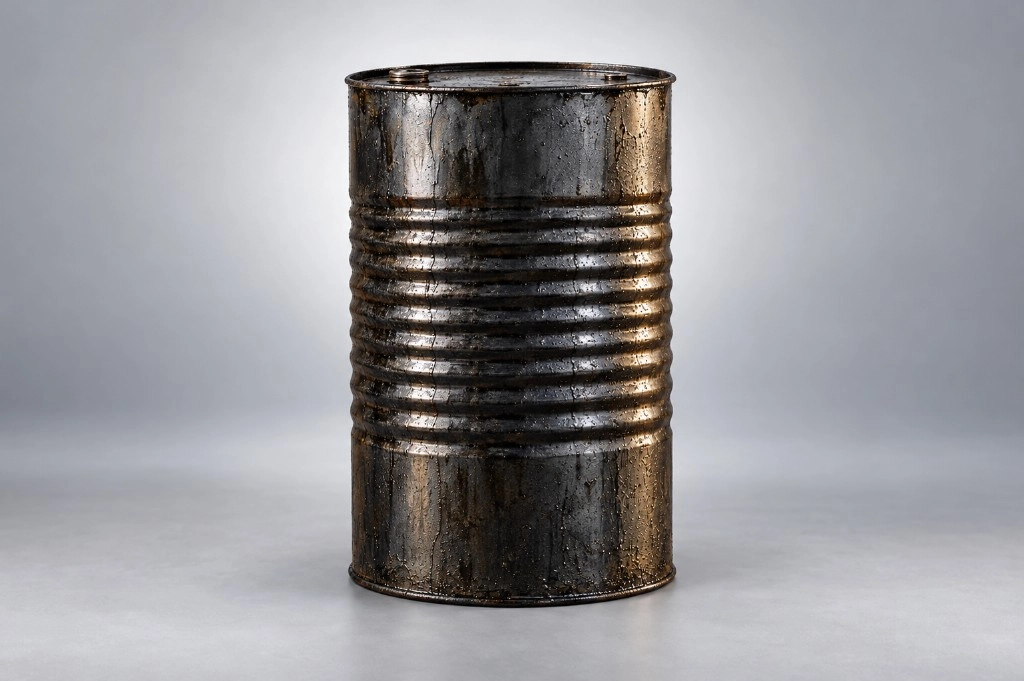
New Cold-Rolled Steel Drums (180 kg net)
The global benchmark for shipping penetration (Pen 60/70, 80/100, 40/50) and viscosity grades (VG30, VG40). Produced strictly from brand-new, non-reconditioned cold-rolled steel sheet (0.6 mm body, 0.7 mm triple-seamed lid and bottom) to eliminate leakage and contamination risks during ocean transit.
- Container Stowage & Port Formats: Long new steel drums (180 kg net, ~980 mm height) represent the universal export standard (>80% of projects), loaded either palletized or floor-loaded (up to 110 drums).
- Physical Dimensions & Tare: Outer diameter ~500 mm × height ~980 mm; empty tare weight approx. 8.5–9.5 kg; manufactured from 0.6 mm cold-rolled steel shell with 0.7 mm triple-seamed heads; air-pressure leak tested.
- Thermal Filling & Expansion: Filled hot at 145–155°C with an engineered ullage (expansion gap) to prevent drum deformity under tropical voyage conditions; cools into an ambient solid core that requires zero heating during sea transit.
- Discharge & Decanting: Emptied via continuous bitumen drum decanters (melting rate 3–6 MT/hour using burner or thermal oil heat). Cold stripping leaves approximately 3–4% heel residue on drum walls compared to zero-residue bag alternatives.
02 · ZERO WASTE / HIGH PAYLOAD
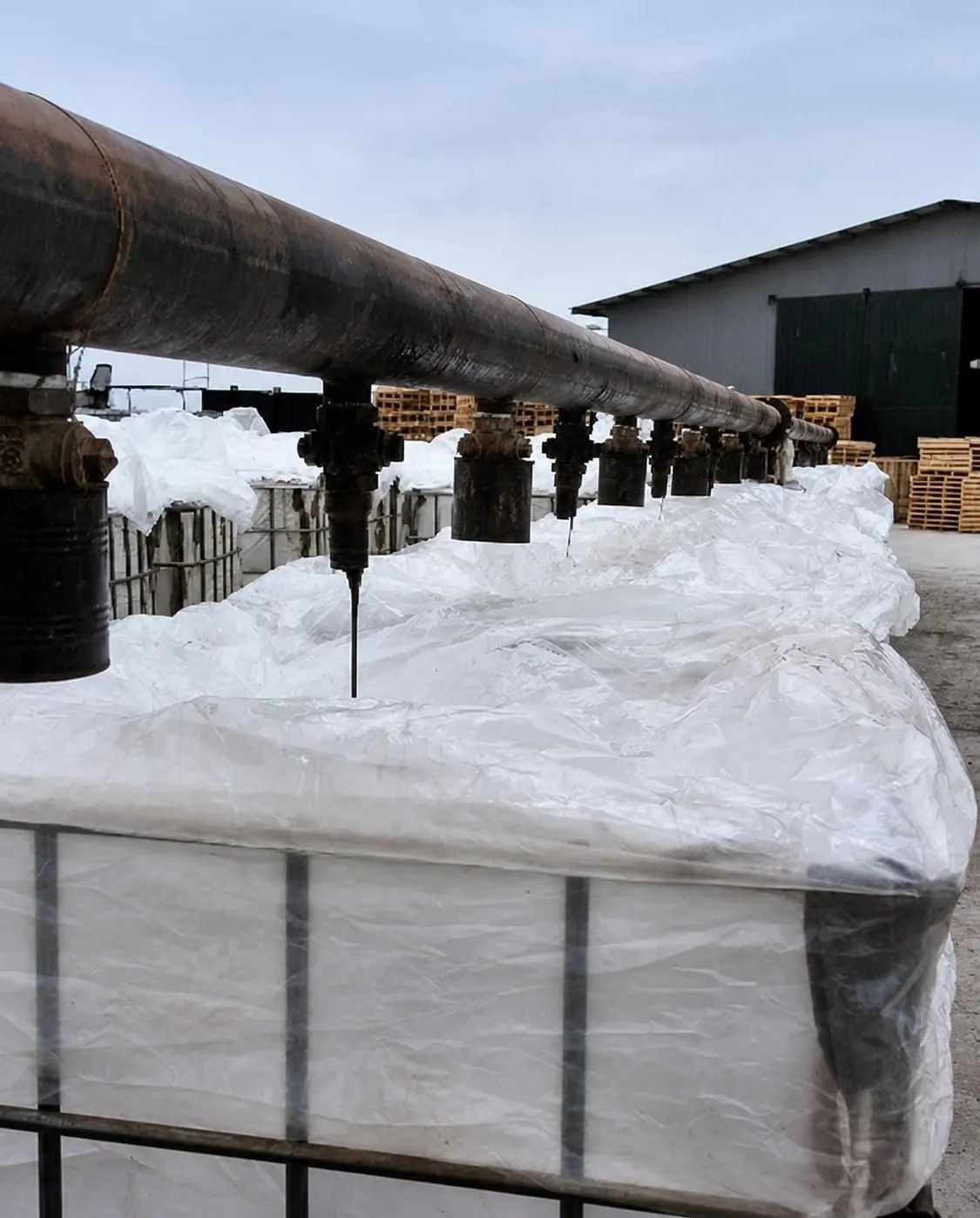
Meltable FIBC Jumbo Bags (300 kg, 1,000 kg and 1,300 kg)
The most economical and eco-friendly packaging format for asphalt concrete mixing plants, also known in global bitumen trade as Bitu-bag, Poly-cube, or Bitu-plast. Engineered to maximize container freight economics while completely eliminating steel scrap disposal and binder residue.
- Payload Advantage: Delivers 20.0 metric tons net per 20ft container (20 bags of 1,000 kg), with no steel drum tare inside the box.
- Bag Sizes: 300 kg (100×55×55 cm), 1,000 kg in a steel cage on a wooden pallet (100×105×105 cm) and 1,300 kg (140×101×101 cm). The 20.0 MT container payload refers to 1,000 kg bags.
- Dual-Layer Multi-Polymer Design: Built with an exterior UV-stabilized woven polypropylene (PP) outer bag (recyclable) and an internal multi-layer consumable poly-alkene liner (~120–150 μm).
- 100% Meltable Inner Liner (Zero Waste): At destination batching plants, the outer PP bag is removed and the entire bitumen block is charged into the melter kettle. The inner liner dissolves completely at 145–160°C, dispersing homogeneously into the asphalt mix with 0% bitumen waste (recovering the 3–4% lost in drum decanting).
- Filling & Handling Stability: Filled at lower controlled refinery temperatures (110–120°C) and cooled into a rigid self-standing block in refinery staging yards. Handled via 4 cross-corner heavy-duty lifting loops; each 1,000 kg bag sits in a steel cage on a wooden pallet (100×105×105 cm) for secure double-tier warehouse stacking.
03 · CONTAINERIZED LIQUID BULK
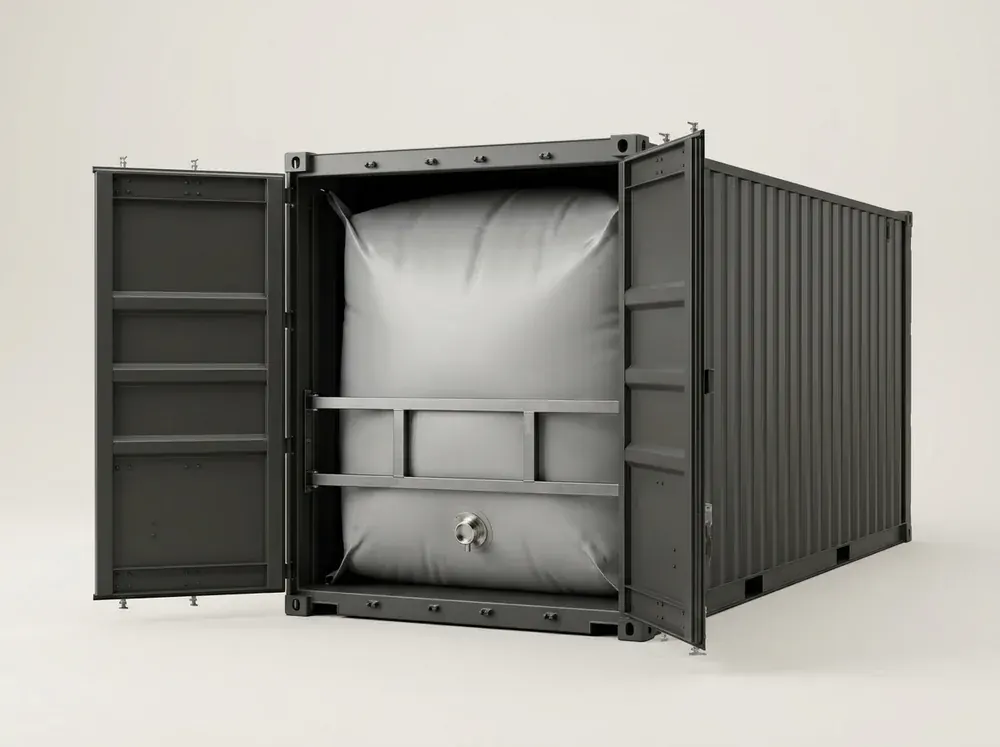
High-Temperature Bitumen Flexitanks (20 MT)
Enables bulk liquid bitumen transport within standard dry container liner shipping networks, bypassing the high charter costs and terminal restrictions of dedicated marine bitumen tankers. Constructed as a multi-layer heat-resistant bladder of polyethylene (PE) or polypropylene (PP).
- Payload & Volume: Engineered for 14,000 to 24,000 L volume, delivering an optimal liquid payload of 20.0 metric tons per container box.
- Strict 20ft Container Deployment: Flexitanks must strictly be installed in 20ft ocean dry containers (prohibited in 40ft containers by shipping line safety regulations). Full four-wall container support and a reinforced heavy-gauge steel door bulkhead are structurally required to absorb dynamic hydraulic surge during sea transit.
- Insulation & Thermal Loading: Container floors and walls are pre-lined with heat-insulating corrugated board before bladder positioning. Molten bitumen enters at a controlled maximum temperature of 110–120°C, then stabilizes into high-viscosity binder before container doors are sealed.
- Destination Thermal Reheating: Discharged using an integrated bottom steam heating pad or thermal oil exchanger. Reheated at destination port or storage depot in 6–8 hours to restore pumpable fluid viscosity (135–145°C) for direct pumping into stationary storage tanks.
04 · OCEAN VESSEL PARCELS
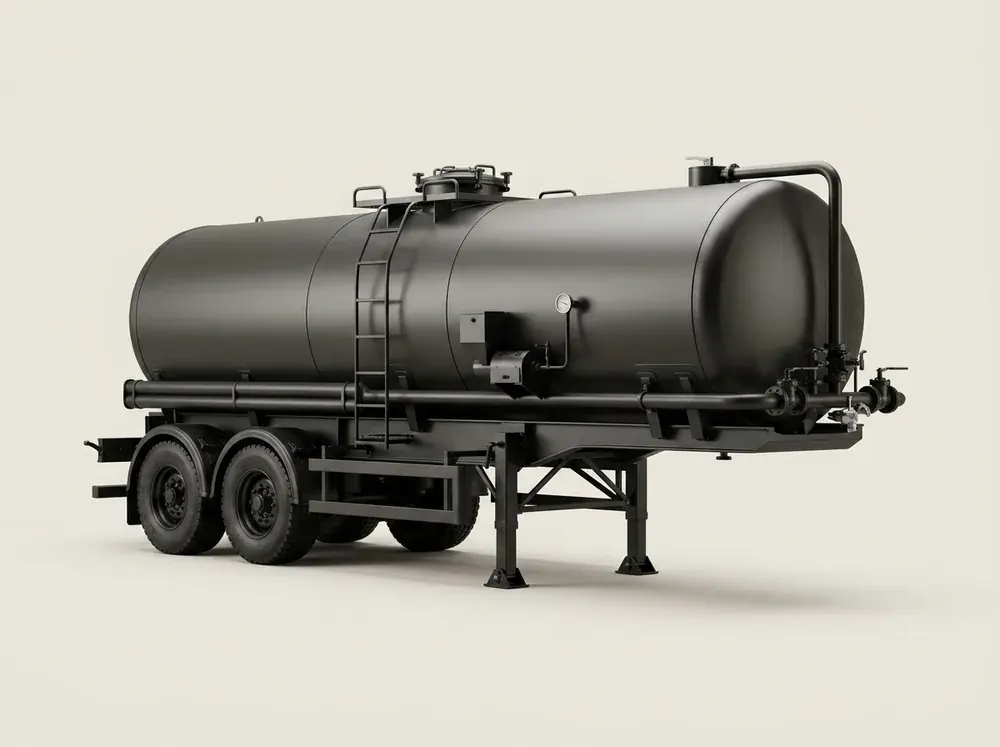
Bulk Bitumen Vessels (3,000 – 10,000 MT Parcels)
The definitive logistics solution for national highway megaprojects, government road authorities, and regional coastal bitumen storage terminals. Parcels load on double-hull insulated specialized bitumen carriers equipped with thermal-oil heating coils.
- Zero Packaging Tare & Cost: The contract price reflects 100% active binder mass and maritime freight — zero expenditure on steel drums, pallets, liners, or disposal operations.
- Continuous Temperature Maintenance: Cargo holds maintain binder at continuous pumping temperature (145–165°C) throughout ocean voyage and port approaches.
- High-Speed Shore Pumping: Vessel cargo screw pumps discharge at rates of 350 to 650 MT per hour directly into shore storage tanks, minimizing berth laytime and vessel demurrage.
- Quality & Custody Transfer: Continuous automated ullage and temperature logging. Every lot is lab-tested in Bandar Abbas before shipment. Pre-shipment inspection is carried out by SGS or Geochem, as the buyer chooses.
Container Count & Freight Savings Estimator
Input your required contract tonnage and estimated sea freight rate to see container counts and freight per metric ton for jumbo bags and flexitanks. Steel drum container counts are confirmed by the trade desk for each order.
Drums vs jumbo bags vs flexitanks: freight, road limits and waste
How ocean container freight rates and destination equipment dictate the most cost-effective packaging choice for your procurement contract.
1. Sea Freight Rate Sensitivity
On short sea routes where container freight is low (e.g. $400–$600 per container), steel drums remain cost-competitive. However, on long-distance lanes (Africa, Southeast Asia, Latin America) where container freight exceeds $1,500–$2,200 per box, freight per metric ton decides the format: jumbo bags and flexitanks load 20.0 MT net per 20ft, so compare freight per MT for each format in your quotation.
2. Destination Road Weight Limits
Several import destinations (such as inland ports in India, Bangladesh, and East Africa) enforce strict gross vehicle weight and container axle limits of 21.5 to 24 metric tons. Confirm the corridor limit with your inland haulier before choosing a format; 20 MT loads may require pre-cleared heavy-haulage highway routes.
3. ESG & Environmental Scrap
Every decanted drum leaves contaminated steel scrap and binder residue on the drum walls. Jumbo bags with meltable liners eliminate 100% of binder residue and steel scrap, aligning perfectly with modern environmental and carbon footprint standards on major infrastructure contracts.
Destination Port Stowage & Packaging Advisor
Chittagong & Mongla Ports
Nhava Sheva (JNPT) & Mundra to ICDs
Mombasa Port (Kenya & Transit Hub)
Dar es Salaam (Tanzania & Transit)
Yangon & Thilawa MITT Terminals
Jakarta (Tanjung Priok) & Surabaya
Cat Lai (HCMC) & Hai Phong Ports
Jebel Ali & GCC Regional Hubs
Zhanjiang, Ningbo & Qingdao
Bitumen Grade Compatibility & Procurement Rules
International bitumen trade is strictly constrained by chemical composition and temperature physics. Not every packaging format is legally or technically compatible with every bitumen family. Review the mandatory engineering rules below before submitting an import RFQ:
| Bitumen Family & Grades | New Steel Drums (180 kg) | Meltable Jumbo Bags (1,000 kg) | High-Temp Flexitank (20 MT) | Engineering & Chemical Rationale |
|---|---|---|---|---|
| Penetration Grades Pen 60/70 · 80/100 · 40/50 |
✓ Universal Standard
100% compliant. Dominant in Africa & Central Asia; weatherproof for up to 18 months outdoor site storage.
|
✓ Batch Plant Benchmark
Consumable poly-cube liner melts at 145–160°C. 0% binder residue; 20 MT net per 20ft container.
|
⚡ Conditional (Boiler Required)
Requires destination steam pad reheating to 135–145°C. Economical for coastal terminals.
|
Refinery straight-run binder with high thermal stability. Fully compatible across all formats provided destination possesses appropriate reheating plant.
|
| Viscosity Grades VG-10 · VG-30 · VG-40 (IS 73) |
⚡ Permitted (Scrap Penalty)
Widely accepted, but NHAI road project guidelines penalize drum scrap disposal and 3–4% decanter heel loss.
|
✓ Indian Highway Standard
Dominant format for NHAI road corridors. Melts cleanly in asphalt batching plant kettles with zero solid waste.
|
✓ High-Volume Liquid
Standard choice for liquid storage tanks at port-adjacent terminals and commercial drum decanting yards.
|
Standardized by absolute dynamic viscosity at 60°C. Poly-cube meltable bags preserve exact kinematic viscosity and penetration values without thermal cracking.
|
| Cutback Bitumen MC-30 · MC-70 · MC-250 |
✓ Steel drums
Strictly packed in heavy-gauge tight-head steel drums with solvent-proof Viton or PTFE gaskets.
|
✕ STRICTLY PROHIBITED
Solvent diluents (kerosene/naphtha) rapidly dissolve polyethylene (PE) liners, causing immediate catastrophic failure.
|
✕ PROHIBITED (IMDG HAZMAT)
Solvents degrade flexitank polymer bladders. Flash point <65°C classifies cargo as IMDG Class 3 Flammable Liquid.
|
Contains 15–45% volatile petroleum solvent diluent. Liquid at ambient temperatures and highly flammable; international container shipping lines legally prohibit cutbacks in flexitanks.
|
| Bitumen Emulsions CRS-2 · SS-60 · K1-60 (BS 434) |
✓ Phenolic Lined Drums
Standard 200L steel drums must feature internal phenolic epoxy lining to prevent acid corrosion and iron contamination.
|
✕ INCOMPATIBLE (LIQUID)
Emulsions are fluid liquids at 20–60°C and cannot form solid self-standing blocks required for FIBC bags.
|
✕ PROHIBITED (SHEAR RISK)
Hydraulic voyage sloshing and pump shear trigger premature emulsion breaking (water separation & hard sludge).
|
Micro-droplet dispersion of bitumen in water stabilized by cationic or anionic chemical emulsifiers. Must be shipped in lined steel drums or 1,000L composite IBC totes; protect from frost.
|
| Polymer Modified (PMB) PG 76-22 · PMB 40 (PMA) |
✓ Certified Solid Block
Cools into a solid homogeneous core. Re-melted on site in high-shear agitated decanting tanks.
|
✓ OPTIMAL GLOBAL PRACTICE
Rapid cooling into solid 1,000 kg blocks immobilizes SBS polymers, preventing phase separation during ocean transit.
|
✕ HIGH RISK (PHASE SEPARATION)
Prolonged molten transit causes SBS polymers to float and separate (syneresis); impossible to mechanically stir in container.
|
SBS elastomer polymer blends require continuous mechanical agitation when molten. Solid packaging (jumbo bags/drums) physically freezes the cross-linked polymer morphology in place.
|
| Oxidized Bitumen 75/25 · 90/10 · 90/15 · 115/15 |
✓ Open-Head Drums (180 kg)
Removable lid allows contractors to cut solid bitumen chunks for direct feeding into roofing kettles.
|
⚡ 25 kg Cartons & Meltable Bags
25 kg cartons (60×40×20 cm), palletized and shrink-wrapped at about 1 MT (±10%) per 110×110 cm pallet, or meltable polyamide bags of 25–50 kg (melting point 160–180°C).
|
✕ IMPOSSIBLE (SOLID AT 100°C)
Extremely high softening points (75°C to 125°C). Cannot be pumped or heated inside flexitanks without severe cracking.
|
Blown petroleum bitumen formulated with elevated softening points for industrial waterproofing and pipe coating. Handled as room-temperature solid blocks in drums, 25 kg cartons or meltable polyamide bags.
|
Field Decanting, Melters & Bitumen Reheating Engineering
Discharge speed and fuel consumption directly dictate your project's net operating cost per metric ton. Compare the four primary field reheating systems:
Hydraulic Continuous Drum Melting Oven
Enclosed Bag Melter Box with Consumable Liner
Low-Pressure Boiler Bottom Steam Reheating
Marine Loading Arm & Screw Cargo Pump Discharge
Bitumen packaging — common questions
Clear, documented answers to the most common questions asked by international bitumen buyers and logistics coordinators.
How many 180 kg bitumen drums fit in a 20ft container?
A standard 20ft dry container takes new steel drums of bitumen (180 kg net per drum) loaded upright, either palletized or floor-loaded (up to 110 drums).
What are the standard dimensions and steel thickness of a 180 kg bitumen drum?
A standard 180 kg export bitumen drum has an outer diameter of approximately 500 mm, an overall height of 980 mm, and an empty tare weight of 8.5–9.5 kg. The drum shell is formed from 0.6 mm cold-rolled steel sheet, and the triple-seamed top and bottom ends are 0.7 mm gauge, pressure-tested to prevent leakage during ocean transport.
What is the net payload difference between steel drums and jumbo bags?
New 180 kg steel drums ship up to 110 per 20ft container, palletized or floor-loaded, and the trade desk confirms the drum count for each order. 1,000 kg jumbo bags carry 20.0 MT net per 20ft container with no steel drum tare. On long sea freight routes, compare freight per metric ton for each format before you choose.
Can bitumen jumbo bags be safely stacked in warehouses?
In ocean transit inside 20ft containers, 1,000 kg jumbo bags are loaded in a single tier of 20 bags for maximum stability. In destination warehouses or asphalt plant storage yards, palletized or framed jumbo bags can be safely stacked up to two tiers high on flat, reinforced concrete flooring.
Do jumbo bag inner liners melt completely without contaminating asphalt mixes?
Yes. HOMAN jumbo bags feature a specially engineered multi-layer meltable polyethylene (PE) inner liner designed to melt completely at 145–160°C within the asphalt plant mixing kettle. The polymer disperses homogeneously and becomes an integral part of the asphalt mixture without altering the penetration or softening point of the binder.
Can penetration grade bitumen 60/70 and 80/100 be shipped in flexitanks?
Yes. Penetration grades 60/70 and 80/100 can be shipped in specialized high-temperature bitumen flexitanks up to 20 metric tons per 20ft container. Flexitanks require destination facilities equipped with steam heating pads or thermal oil circulation systems to reheat the binder to pumping viscosity (approx. 135–145°C) prior to discharge.
What is the international HS code for bitumen export in drums, bags and bulk?
Refinery grade petroleum bitumen is classified internationally under HS 2713.20 (petroleum bitumen; national tariff suffixes vary). Cutback bitumens are typically classified under HS 2715.00, and bitumen emulsions under HS 2715.00. HOMAN provides commercial invoices, packing lists, and Certificates of Origin declaring HS 2713.20 with the applicable national tariff suffix.
What inspection certificates accompany HOMAN export packaging?
A Certificate of Analysis (COA) is provided for each order lot, supported by refinery laboratory results and SGS or Geochem inspection prior to shipment. Units are batch-numbered for traceability.
Which destination ports enforce specific bitumen packaging or container weight restrictions?
Ports such as Chittagong (Bangladesh) and inland ICDs in India (Tughlakabad, Dadri) enforce strict highway and bridge gross axle weight limits (21.5–24 MT GVW). In East Africa (Mombasa and Dar es Salaam), EAC weighbridge regulations at Mariakani and Kibaha strictly penalize axle overloads, favoring palletized drums unless multi-axle heavy trailers are pre-contracted for 20 MT bags or flexitanks. In Southeast Asia (Yangon, Jakarta), palletized drums or 1,000 kg jumbo bags prevent manual destuffing delays and container demurrage.
What are the current payment terms?
Packaging is quoted inside the commercial offer: standard terms are 30% advance and 70% against shipping documents (FOB) or after Bill of Lading issuance (CFR). Full terms are on the bitumen price and terms page.
Can Cutback Bitumen (MC-30, MC-70, MC-250) be shipped in flexitanks or jumbo bags?
No. Cutback bitumen is strictly prohibited in standard flexitanks and jumbo bags. The petroleum solvent diluents (kerosene or naphtha) chemically dissolve polyethylene (PE) inner liners within hours, causing catastrophic liner rupture and cargo loss. Furthermore, flash points as low as 38°C for MC-30 classify cutbacks as IMDG Class 3 Flammable Liquids, which international maritime container carriers prohibit in flexitanks. Cutback packaging (steel drums or ISO tank containers) is confirmed per order.
Why is Bitumen 60/70 almost exclusively imported in new steel drums across East and West Africa?
Penetration grade 60/70 is shipped almost exclusively in new steel drums across East, West, and Central Africa due to five structural logistical factors: (1) remote interior road project sites lack heated bulk storage tanks or steam boiler stations; (2) unpaved overland transit corridors cause high puncture risks for soft packaging; (3) extreme tropical rainfall demands weatherproof packaging that can be stored in open jobsite yards for 12–18 months without water ingress; (4) regional weighbridge enforcement (such as EAC Mariakani and Kibaha) strictly enforces axle weight limits; and (5) civil road contractors utilize decentralized continuous drum decanters powered by direct diesel burners.
How does packaging format affect Polymer Modified Bitumen (PMB / PG 76-22) storage stability?
SBS polymer modified bitumens are susceptible to polymer phase separation (polymer stratification and syneresis) when kept molten in unagitated bulk tanks or flexitanks over long sea voyages. Packaging PMB in solid 1,000 kg jumbo bags or 180 kg steel drums cools and immobilizes the polymer network homogeneously into a solid matrix, preventing phase separation during transport. When melted fresh at the destination asphalt batching plant with high-shear kettle agitators, the original viscoelastic properties, elastic recovery, and rutting resistance are fully preserved.
What is the decanting energy requirement and bitumen residue loss across drums vs jumbo bags?
Decanting standard 180 kg steel drums requires approximately 18–25 liters of fuel per metric ton and leaves 3.0% to 4.5% (approx. 5.5–8.0 kg) of binder stuck as unrecoverable heel residue on inner drum walls, alongside generating one empty scrap drum per 180 kg of binder. In contrast, 1,000 kg meltable jumbo bags operate with modern thermal oil melting units consuming only 12–16 liters of fuel per metric ton, leave 0.0% binder residue because the inner consumable poly-liner melts directly into the asphalt batch, and produce clean recyclable polypropylene sacks.
Payloads and discharge temperatures last reviewed: 9 October 2026. Specifications follow refinery COA per lot.
Bulk · Drums · Jumbo bags · FlexitanksTrade desk quotation.
Specify the lot. Get a quotation.
Grade, tonnage, packaging, Incoterm and port — send those five lines and the trade desk issues a quotation.
Trade desk quotation on request.Every lot is lab-tested in Bandar Abbas before shipment. Pre-shipment inspection is carried out by SGS or Geochem, as the buyer chooses. A Certificate of Analysis (COA) is issued for each order lot and tied to the batch number on the packaging.