
Bitumen 40/50 — Penetration Grade
The hardest of the penetration grades we ship — specified where high ambient temperature and heavy axle loading would push a softer binder into rutting.
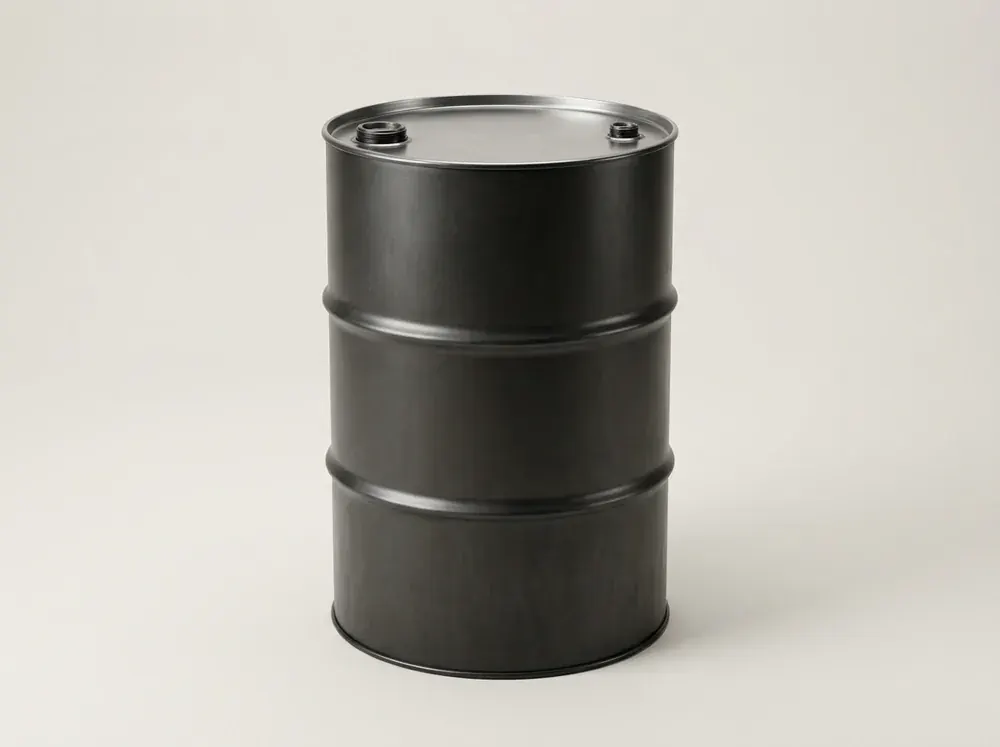
Bitumen 40/50 is the hardest penetration grade HOMAN ships: a needle penetrates 40–50 dmm at 25 °C and the softening point is 52–60 °C. It is chosen for hot climates and heavy axle loads where rutting is the main risk, and is exported in 180 kg drums, jumbo bags, flexitanks or bulk.
Choose 40/50 when the specification needs a harder penetration band than 60/70 — typically hot climates and heavy axle loads where rutting, not cold cracking, is the risk. It is not interchangeable with 60/70, 80/100 or a viscosity grade such as VG30 unless the project specification allows it.
- Designation
- Pen 40/50
- Key property
- Penetration 40–50 dmm @ 25 °C
- Family
- Paving
- Documentation
- COA per order lot
Technical properties
Each row names the test method the value is measured by, so your inspection lab can reproduce it.
| Property | Unit | Test method | Specification |
|---|---|---|---|
| Specific Gravity at 25 °C | — | ASTM D70 | 1.01–1.06 |
| Penetration at 25 °C, 100g, 5s | 0.1 mm | ASTM D5 | 40–50 |
| Softening Point | °C | ASTM D36 | 52–60 |
| Ductility at 25 °C | cm | ASTM D113 | Min 100 |
| Loss on Heating | % m/m | ASTM D6 | Max 0.2 |
| Drop in Penetration after Heating | % | ASTM D5 | Max 20 |
| Flash Point | °C | ASTM D92 | Min 250 |
| Solubility in Trichloroethylene | % m/m | ASTM D2042 | Min 99 |
| Spot Test | — | AASHTO T102 | Negative |
Limits per the HOMAN 40/50 technical datasheet. Penetration class per ASTM D946; each property is measured by the test method shown.
Datasheet issued by the HOMAN technical team · Lot testing: Bandar Abbas laboratory · Inspection: SGS or Geochem
Download PDF (88 KB) Download MSDS (117 KB)40/50 vs 60/70 bitumen (and VG40)
40/50, 60/70 and VG40 side by side, with the test method for each limit.
| Property | Test method | 40/50 | 60/70 | VG40 |
|---|---|---|---|---|
| Penetration at 25 °C (0.1 mm) | ASTM D5 | 40 – 50 | 60 – 70 | Min 35 |
| Softening point (°C) | ASTM D36 | 52 – 60 | Min 46 | Min 50 |
| Flash point (°C) | ASTM D92 | Min 250 | Min 250 | Min 220 |
| Loss on heating (% m/m) | ASTM D6 | Max 0.2 | Max 0.2 | — |
| Ductility at 25 °C (cm) | ASTM D113 | Min 100 | Min 100 | — |
Limits as published on the HOMAN 40/50, 60/70 and VG40 datasheets. 40/50 vs 60/70 is the usual hot-climate decision; VG40 is the IS 73 viscosity-graded alternative where Indian-style tenders apply. VG40 ductility is specified on RTFOT residue (IS 73) and is not comparable.
Specified for
01
Wearing and binder course in hot climates
02
Heavy-duty industrial pavement
03
High axle-load corridors
Packed for the voyage
Batch-numbered for traceability.
Shipment quality documentation
Every lot is lab-tested in Bandar Abbas before shipment. Pre-shipment inspection is carried out by SGS or Geochem, as the buyer chooses. A Certificate of Analysis (COA) is issued for each order lot and tied to the batch number on the packaging.
Other paving grades
Choose by the designation your specification names — penetration band, viscosity grade or class number. All three describe the same material measured a different way.
Pen 40/50 — common questions
What does bitumen 40/50 mean?
The numbers are the penetration range: a standard needle (100 g, 5 s, 25 °C) sinks 40 to 50 tenths of a millimetre into the sample. Lower penetration means a harder binder, so 40/50 is stiffer than 60/70 or 80/100.
What is bitumen 40/50 used for?
Wearing and binder courses in hot climates, heavy-duty industrial pavements and high axle-load corridors, where a softer grade would rut under summer temperatures.
What is the difference between bitumen 40/50 and 60/70?
40/50 is harder: penetration 40–50 dmm against 60–70 dmm, and a softening point of 52–60 °C against a minimum of 46 °C on the HOMAN datasheets. Pick 40/50 for hotter, heavier corridors; 60/70 remains the general-purpose grade.
What is the softening point of bitumen 40/50?
52–60 °C by the ring-and-ball method (ASTM D36), per the HOMAN 40/50 datasheet.
What are the bitumen 40/50 specifications?
Penetration 40–50 dmm (ASTM D5), softening point 52–60 °C (ASTM D36), ductility min 100 cm (ASTM D113), flash point min 250 °C (ASTM D92), solubility min 99 % (ASTM D2042), loss on heating max 0.2 % and a negative spot test.
What is the specific gravity of bitumen 40/50?
1.01–1.06 at 25 °C (ASTM D70), per the HOMAN datasheet. The exact value is reported on the COA for each lot.
What is the HS code for bitumen 40/50?
HS 2713.20 (petroleum bitumen; national tariff suffixes vary), as declared on HOMAN invoices and certificates of origin.
What is the price of bitumen 40/50 per ton?
It is quoted per metric ton and moves with tonnage, packing, Incoterm and port. One 180 kg drum is 0.18 MT, so a ton is about 5.6 drums. Send these details to the trade desk for a current FOB or CFR offer.
Which standard does HOMAN 40/50 follow?
HOMAN 40/50 is penetration-graded under ASTM D946, with each property tested by the ASTM method shown on the datasheet.
Is bitumen 40/50 the same as EN 40/60 or 35/50?
No. 40/50 is a penetration grade with a 40–50 dmm band at 25 °C. EN 12591 grades 35/50 and 40/60 use different, overlapping bands and their own limits. If your tender names an EN grade, send the specification and the trade desk will confirm whether a lot can be tested and reported against it.
Active since 2016 · Exports to 11 countries · Offices in Tehran and Shenzhen · Minimum order: one container
Bulk · Drums · Jumbo bags · FlexitanksTrade desk quotation.
Specify the lot. Get a quotation.
Grade, tonnage, packaging, Incoterm and port — send those five lines and the trade desk issues a quotation.
Trade desk quotation on request.Every lot is lab-tested in Bandar Abbas before shipment. Pre-shipment inspection is carried out by SGS or Geochem, as the buyer chooses. A Certificate of Analysis (COA) is issued for each order lot and tied to the batch number on the packaging.